Showing posts with label Cooking class. Show all posts

Wednesday, April 22, 2020

How to Spatchcock a Chicken: A Step-by-Step Guide | 蝴蝶式全雞開邊法

附中文做法
For many a seasoned home cook, roasting whole chicken may be like a walk in the park; but for the vast many others, me including, roasting chicken instills a certain fear. There is often that most daunting fear that the chook cooks unevenly, with the breast turning into rubber while the drumstick runs pink; the hassle of turning, flipping, and then the basting; oh, and the long wait. For yet others, there is the issue with size - their oven is so petite that it can barely accommodate even a small bird lying on its tummy. Trust me, I have been there, done that. Nothing feels more comforting than a juicy roast chicken on a Sunday, yet for the longest time I have denied myself this ultimate pleasure for fear of failure and hassle.

This was all about to change when I learned how to spatchcock a chicken, which is just a fancy way of saying to butterfly a chicken. By removing the backbone from tail to crown and laying the chicken flat like an open book, you essentially turn something three-dimensional into two, not only creating a more even surface to cook evenly, but also exposing more skin, which crisps up nicely under high temperature - and who doesn't go nuts over crispy skin?! (Those who discard and push the skin to the edge of the plate, pass them over please.)

Another main advantage of spatchcocking a chicken is faster cooking time, whether on the grill or roasting in an oven. Time after time, I will have a perfectly juicy, tender roast chicken ready in just 35 minutes - a whopping third faster than roasting a chicken whole. Additionally, a butterflied chicken makes a wonderful palette for marinating, given the easier access to the cavity and exterior.

A whole chicken from the supermarkets in Hong Kong typically comes with the full package - head, neck, feet and all but the giblets. Spatchcocking is like operating a surgery. For first-timers, the process may get you a wee bit queasy especially with the poor bird staring back at you. Memories of dissecting a dead frog in biology lab may flash back. Go ahead, chop the head off and discard it out of sight to calm the guilt but never do so without giving thanks. If anything, spatchcocking a chicken allows us to be just one step closer to understanding and appreciating the animals that feed us. And if this step hasn't converted you into vegetarianism yet, go on and proceed with a pair of sharp kitchen shears.

Advantages of spatchcocking:
•  More even cooking - consistently tender and juicy
•  Greater surface area for crispy skin
•  Short cooking time - approx. 35 minutes
•  No flipping and turning necessary
•  Great for marinating
•  Perfect for both oven roasting and grilling
  Excellent for smaller ovens
•  No carving necessary - just section the chicken off when serving
•  You get to practice CPR
 
At the risk of sounding exaggerated, I dare say learning to spatchcock a chicken was positively life-changing. Consistent, juicy results every time. All my fears for roasting chicken dissipated, and not for a second do I consider going back to roasting a chicken whole, ever.

此不再恐懼烤全雞!把雞剪開成蝴蝶狀,使全雞在同一個平面及相同的厚度均勻受熱,除了大大縮減烤焗時間,更能每次都做出嫩滑多汁、皮脆可口的效果!— 拖延已久,終於完成了這一個小小的 tutorial 跟大家分享不敗烤雞秘訣 : 

{ A Step-by-Step Guide: Let's Begin }

Grab your kitchen shears

Pat your chicken dry. Remove and discard the head and neck. Cut feet off at the joint of the drumstick. Set aside.
雞洗淨,抹乾水份。用剪刀去掉頭、頸和雞腳。

Cut along the backbone

Starting at the tail, cut along one side of the backbone with kitchen shears. Make the cut as close to the spine as possible.
雞背向上,用剪刀沿著雞背脊椎的兩側將雞背剪開。


Remove the backbone

Repeat on the other side of the spine toremove the entire backbone from neck to tail.
再剪另外一邊,剪出整條雞背骨。


Trim and clean

Trim excess fat and clean out the cavity. Reserve backbone and feet for stock or freeze for later use — do not discard!
清除多餘脂肪和所有內臟殘餘物。雞背骨和雞腳可雪藏備用來造高湯。


Flatten the chook

Now, on to my favorite step: "give CPR". With breast side up, press down firmly in the middle of the breastbone to flatten the bird — you will hear a sensational crack. This step is dangerously satisfying.
「心肺復甦術」: 雞胸向上,用掌心於胸骨中央用力壓一壓,隨即會聽見「啪啦」一聲,將全雞壓平。


Get under the skin

For maximum flavor, you want to get your marinade under the skin. Carefully use your finger to create pockets between the skin and the flesh in the breast and thigh. Be careful not to break the skin!
用手指輕輕把雞胸和雞腿的皮與肉之間分隔開,有助塞進醃料另雞肉醃得更為入味。


You've just spatchcocked!

Well done — your chicken is now relaxed and ready for the marinade and the grill!
成功把雞開背成蝴蝶狀,下一步加入醃料和烤焗!

Do you like to roast your chicken whole or spatchcocked?
Share with me or leave a comment below! Tag #alvinspenthousekitchen.
Find me on Instagram @alvinckl and @alvin.penthousekitchen and follow my Facebook Fan Page!

Friday, April 10, 2015

Thai Spicy Ground Pork Salad | 泰式肉碎沙律 | Larb Moo


Just in time for the Songkran Festival in Thailand - known to many as the water festival stretching the span of three days in welcoming the Thai New Year - I decided to throw a themed dinner party featuring some of the most loved Thai dishes.

At once exotic as it is now familiar to almost every part of the world, Thai cuisine is a profusion of complex flavors and fragrances, guided by the intricate balance of sweet, sour, spicy, and pungent that varies from region to region. I have long had a love affair with Thai food, but it wasn't until I enrolled in my first ever cooking school experience in Chiang Mai have I gained such insight and respect for this truly sensational realm of cooking.

The shimmering golden stupa of a Wat, my solo trip to Chiang Mai | 2012
Having a blast at the Thai Farm Cooking School!
It is hard not to fall in love with Thai food. Fortunately, creating some of the most iconic dishes can be just as easy at home.

Larb (ลาบ) is a classic Isaan dish originating from Northeastern Thailand, and is typically prepared with pork or chicken. Enjoy it with a ball of warm, fresh sticky rice, or wrap it in a luscious lettuce leaf for a delicious starter or a light lunch. Not unlike many Thai dishes, larb takes its flavors and aromas from fish sauce, lime, chili, and sugar, in addition to shallots, abundant herbs, and - most importantly - toasted sticky rice powder, or khao kua (ข้าวคั่ว).

Although hardly visible once mixed into the pork, khao kua imparts a nutty, smoky fragrance and crunch that is characteristic to larb and many Northeastern style dishes and dips. Toasting and grinding rice is SIMPLE, so don't skip it! All the measurements for seasonings below are approximate, as ultimately it is the tongue that knows best (I second Rachel Ray in that I clearly do not swear by precise measuring in the kitchen).

To prepare...
1/4 cup uncooked Thai sticky rice*
1 lb (460 grams) ground pork
1 tablepoon Thai ground chili^
1 tablespoon fish sauce
Pinch of sugar
1 tablespoon fresh lime juice, plus zest of the limes
4 small shallots, chopped
Handful of chopped spring onion
Handful of fresh mint
Handful of fresh cilantro
2 heads of little gem lettuce, rinsed, to serve


*Note: if unavailable, substitute with pearl rice. I used a Korean short-grain variety.
^Note: if unavailable, use crushed red pepper flakes and chili powder like I did!

1. For the khao kua... Heat a dry frying pan on low heat and toss in uncooked rice. Toast the rice until fragrant and nutty, shaking pan occasionally. Turn heat off as soon as the rice turns golden yellow and begins to brown. Set aside to cool slightly. Pound the toasted rice with a mortar and pestle the traditional way or give it a quick blitz in a blender. Be sure not to grind it into fine powder to keep some crunch.


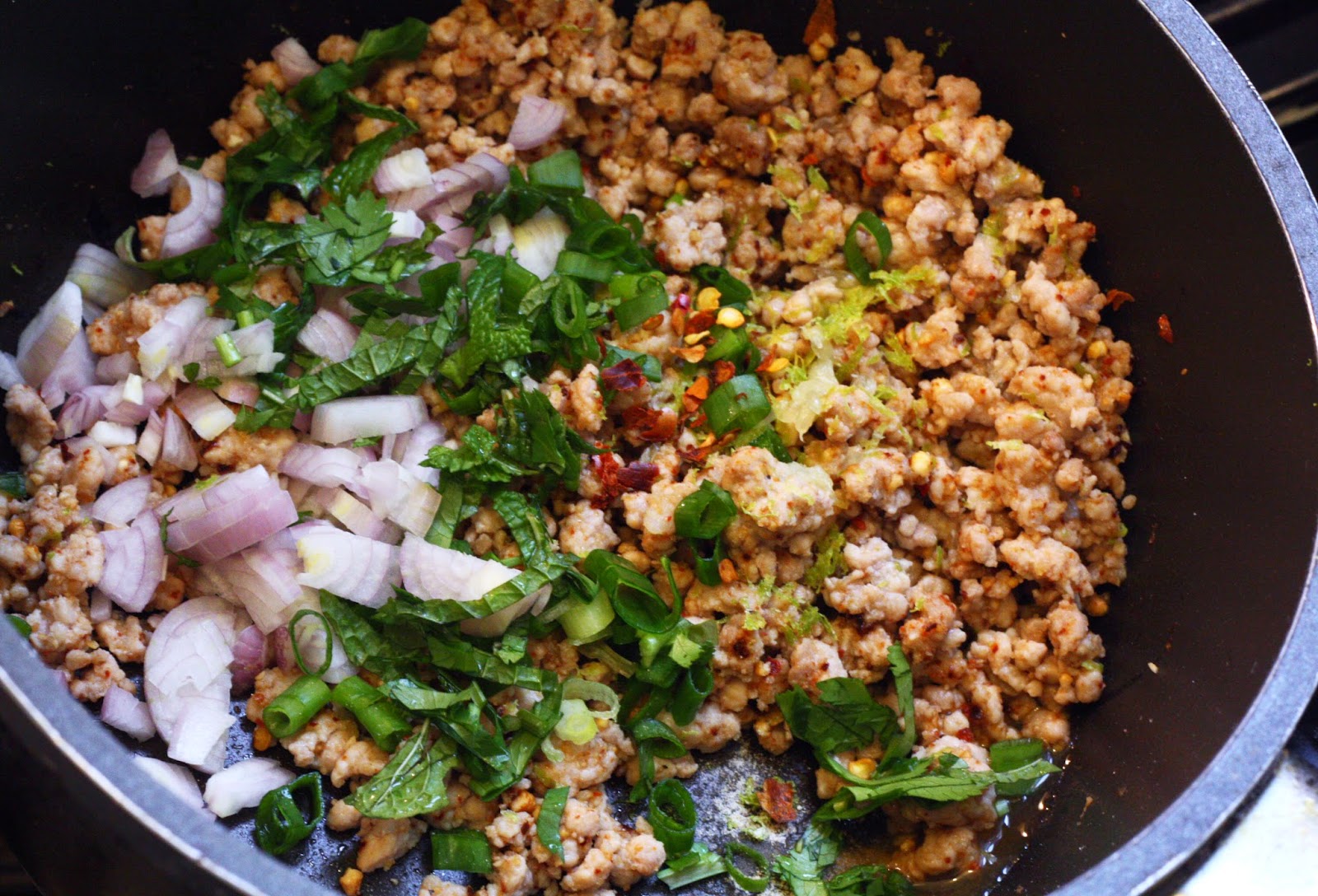
2. For the larb... In a saucepan on medium heat, add ground pork, stirring frequently to break into small pieces until completely cooked. Tip in a heaping tablespoon of toasted rice powder and add chili flakes, sugar, fish sauce, lime juice and zest.

3. In the same pot, mix in chopped spring onion and shallots. Roughly chop some of the mint and cilantro and add to pork mixture. Give the larb a good mix, adding more seasoning and toasted rice until it tastes just right. Be bold!

4. Scatter the remaining mint and cilantro over the larb and dish it out with a fresh bed of gem lettuce leaves. Enjoy!


 【 泰式肉碎沙律 】

泰國新年潑水節將至,唔少遊客都會紛紛快閃泰國濕濕身,當然也不少得豪飲豪食!為響應新年,喺呢度同大家分享最喜愛的泰國東北菜式食譜 — 既辛香惹味又開胃刺激的「肉碎生菜包 ลาบ」! 不過其實生菜包是港式化的享用方式,在泰國多配糯米飯啊~ 如果想炮製出最正宗的東北風味,食譜裡的自製烤米粉 (khao kua) 絕對或不可缺噢!

材料:
泰國糯米          50 克
免治豬肉          460 克 / 1 磅
泰國辣椒粉      1 湯匙
魚露                   1 湯匙
砂糖                   適量
新鮮青檸汁      1 湯匙
乾蔥                   4 顆
                       適量(剁碎)
芫荽                  適量(剁碎)
薄荷葉              適量(剁碎)

烤米粉做法:
用乾鍋烘香糯米,放涼後可用傳統研缽和研杵或攪拌機磨成粉末即成。

肉碎沙律做法:
1. 炒鍋下油預熱,以中火兜炒豬肉至全熟。加入一大湯匙烤米粉、辣椒粉、砂糖、魚露和青檸汁。拌入乾蔥、蔥、芫荽和薄荷葉。拌勻後再依個人口味作調味。
2.  完成後配上各式生菜或糯米飯,風味絕佳!

[Follow me on Instagram @alvinckl and @alvin.penthousekitchen and check out my Facebook Fan Page!]

Thursday, November 20, 2014

Eat, Surf, Cook | Bali

Dear home cooks,

It has been a couple of weeks since my last entry. As some of you might have figured, Alvin's Penthouse Kitchen took some time off, but has hardly stopped cooking or gorging while on vacation!

On an unrelenting quest for adventure, my holiday this month took me back to the enchanting Bali, nearly six months since my last visit. Aspiring to pick up a new sport and a rather extreme challenge, I signed up for a week-long surfing course by the crashing shores of laid-back Kuta, West Bali.

In just days, I experienced the high of standing up on a surf board, the adrenaline rush of successfully catching and riding a rapidly breaking wave. I have, on the other hand, also endured the power of nature as waves double my height slammed like speeding trains, occasionally sweeping me into a helpless heap of laundry tumbling under ferocious currents. The biggest lessons I learned? Get up no matter how many times you fall. And don't mess with Mother Nature.

Fragrant seeds, nuts and spices: the foundation of Balinese cooking
Aside from beach bumming like a surfer, I dove into the world of Balinese cooking. On multiple occasions I have heard this comment from fellow travellers regarding the lack of "good food" on this Island of Gods. And boy, are they sorely mistaken. Apart from the host of international cuisines catering to tourists, Bali boasts a complex, distinctly Balinese food culture, blending indigenous traditions and foreign influences with Indonesian regional cuisines.
Ayam Betutu, a popular Balinese dish

Unlike many parts of Indonesia, Bali's inhabitants are predominantly Hindu, with every aspect of Balinese life steeped in religious belief. Pork, though rarely found in majority Muslim Indonesia, is widely consumed in Bali, making this world-famous island even more magical for hog-lovers like me.

Until attending my cooking class, I had only a vague concept of Balinese food from exploring restorans, warungs, and masakan padangs. Specialties such as bebek betutu, ikan pepes, and sate lilit feature prominently in many restaurants alongside Indonesian favorites like nasi goreng and sop buntut. Rice is consumed almost every meal, with an incredibly complex blend of spices permeating every element of a Balinese dish and its mesmerizing array of spicy sambals.

So what exactly makes Balinese cuisine so remarkable? I decided to find my answers by learning it hands-on. From candlenut to the torch ginger, we learn the basics of Balinese flavors and the base wangen - or fragrant spice paste - used in all ceremonial foods and most everyday dishes. We grind our own ingredients and cook off at the wok station, getting our hands "dirty" massaging meat and tossing salads, finally culminating to a feast of nine dishes all created from scratch.

Grinding spices the traditional way!
Paket Gurame Bumbu Oles
Not only did I walk out will a full belly, but also returned home with a deeper understanding, craving and respect for Balinese food. I look forward to experimenting at home at Alvin's Penthouse Kitchen and sharing with you all!

[Any thoughts or comments? I want to hear from you! Also check out my Facebook Fan Page]